
You say what is wrong
In your words, in the app or the CLI. Point at files with @, paste a screenshot, or pick a mode first.
On the shop's /plans page, picking Yearly still shows the monthly prices. Find out why, fix it, and show me the diff.
It changes your code, runs your tests and shows you every edit before it stays. A native app and a CLI, on your own API key, a model on your machine, or Claude Code with your Claude plan.
7 days free with a card, then $20 a month or $200 a year. Cancel in the first week and nothing is charged. Models are billed by their provider.
At rest the app holds 8.3 MiB of memory, and its own instructions take 778 tokens of a request. Your code never reaches our servers.
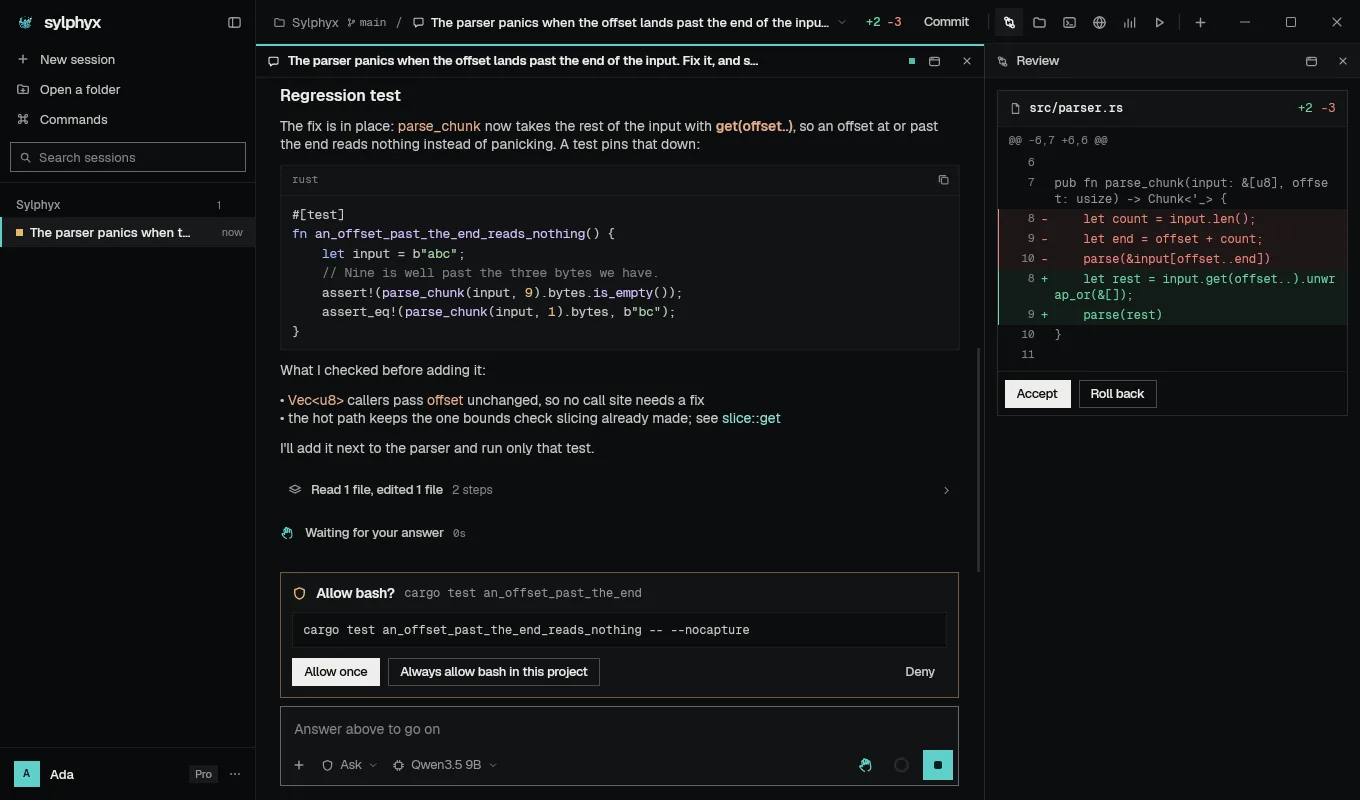
A real task, step by step. Sylphyx does the work and stops wherever you need to decide.
In your words, in the app or the CLI. Point at files with @, paste a screenshot, or pick a mode first.
On the shop's /plans page, picking Yearly still shows the monthly prices. Find out why, fix it, and show me the diff.
It searches, then reads just the lines that matter and names each file as it goes. Your whole repository never gets poured into the model.
search "yearly" in src 3 files
read src/pricing/PricingToggle.tsx lines 12–30
read src/pricing/plans.ts lines 1–24
The edit arrives as a hunk. A checkpoint is taken first, so saying no costs nothing.
src/pricing/PricingToggle.tsx
- const price = (plan: Plan) => plan.monthly;
- const suffix = "/ month";
+ const price = (plan: Plan) =>
+   period === "yearly" ? Math.round(plan.yearly / 12) : plan.monthly;
+ const suffix = period === "yearly" ? … : "/ month";
In your shell, with your tools. When a test fails, it reads the full output and fixes from there.
$ npm test -- pricing
pass shows monthly prices by default
pass shows a twelfth of the yearly price
pass says a yearly plan is billed yearly
Tests 3 passed (3)
Accept the hunk or roll it back. A rollback leaves the file exactly as it was before.
src/pricing/PricingToggle.tsx +3 −2
Commit it yourself, or let it push a branch and open the pull request. The history is plain git.
$ git commit -m "Show yearly prices per month"
[fix/yearly-prices 4be1a07] 1 file changed, 3 insertions(+), 2 deletions(-)
0.8MB
Sylphyx's CLI sitting at its prompt, next to other agents doing the same. We did not measure their numbers ourselves, so take the comparison as rough.
We did not measure the other agents ourselves. Take these numbers as rough.
A script in the repository measures these on one reference machine and keeps the raw samples. They cover size and speed only. Memory during a task, cost and how often tasks get solved are not measured yet.
8.3MiB of 50
16.7MiB of 50
0.8MiB of 43.9
31.3ms of 100
778tokens of 800
Desktop memory is the private working set summed over the app's processes, p95 of each launch, worst of three, in a 1400×860 window, on the build of 13 October 2026. The limit is a twentieth of the lighter of two desktop AI apps we baselined.
The CLI's start is the p95 of 50 warm launches, from process start to a prompt that takes keys with the session store open. Instructions are the system prompt and seven tool schemas, counted with OpenAI's o200k_base tokenizer: 743 to 778 depending on the wire format.
The other agents' figures are approximate idle memory at their prompt and were not taken by our script, so the methods differ and the ratios are rough. Reference machine: Intel Core i5-12600KF, 31.8 GiB, Windows 11 Pro.
778/ 800
Every request starts with the agent's own instructions and the definitions of its tools. Sylphyx keeps both under 800 tokens, with a short system prompt and seven tools. That cap is our own rule, and it leaves the model's context window almost entirely to your code. Edits point at the exact lines the model read, so it rewrites those lines and leaves the rest of the file alone.
Sylphyx brings no model of its own, so it adds nothing to what yours costs. Every session keeps the model you picked for it.
Sylphyx's own sessions, in the app and the CLI
The provider, for what you use
sylphyx login anthropic
sylphyx -m anthropic/claude-opus-5-5Sylphyx's own sessions, on your hardware
Nobody
ollama pull qwen3-coder
sylphyx -m ollama/qwen3-coder
Claude Code, in Sylphyx's built-in terminal
Your Claude plan
claudeEach as itself, in the built-in terminal
Their own accounts
codex
gemini
copilotSylphyx's own sessions
Your ChatGPT plan, once approved
Waiting for OpenAI's approvalUntil then, an OpenAI key works in the same sessions.
sylphyx opens a prompt with history, completions and @ mentions. Shift Tab changes the mode and Ctrl C stops a turn. With -p it takes one task and runs it to the end by itself. At rest it uses less than a megabyte.
The window is the CLI itself, recorded: it reads the file, asks before it writes, shows the diff, and then the effort goes up to Max.
Your messages and the files the tools read go straight from your computer to the provider, under its terms.
LM Studio or Ollama, on your own machine. Nothing leaves it.
Your computer fetches the pages. Search uses your provider's own search or a service you set up (Brave, Tavily, SearXNG). It never goes through Sylphyx.
Never in the settings or the logs. On Linux without a keychain service, they go in a file only your user can read.
Your name, email, plan and signed-in devices, and nothing more. Network addresses are kept for a day at most, to slow down repeated sign-in attempts. The apps ask it for your plan and for updates, and send no usage data.
Every change waits for you unless you switch that off. In full auto on macOS and Linux, commands run in a sandbox that can write only inside the project, with the network left open. Windows has no sandbox yet, so full auto there runs commands with your own rights. If that worries you, stay on Ask or Auto-edit. How Sylphyx is secured
$20a month, after seven free days
Or $200 a year, which is two months free.
You pay your provider for model usage, or nothing with a model on your machine. Sylphyx never marks up a token.
What you pay for
If you stop paying, the apps still open. You can export your sessions and roll back their changes. Only new turns stop.
Start seven days freeA card starts the trial: $1 is held and released at once, and nothing is charged for seven days. You get a full refund within 14 days of a charge if neither the app nor the CLI has been used with your account since (downloading the installer does not count). Your rights as a consumer apply as well. Refund policy. Prices are in US dollars, charged in hryvnias by monobank, from a card in any country.
The download page lists what the latest release has for your system.
$20 a month or $200 a year for the app and the CLI, after seven free days. You pay the model's provider as you use it, or nothing with a local model. Sylphyx never marks up a token.
Claude Pro and Max work today through Claude Code, which runs in Sylphyx's built-in terminal. Anthropic's terms keep plans out of other apps' own sessions, so those sessions need an API key. ChatGPT Plus and Pro will work in Sylphyx's own sessions through Sign in with ChatGPT once OpenAI approves it. Until then they don't.
No. With a cloud model, your code goes from your computer straight to the provider you chose. With a local model it stays on your machine. Our account service knows your name, email, plan and signed-in devices, and that is all.
Every change waits for your review, with a checkpoint taken first. In full auto nothing waits, so on macOS and Linux commands run in a sandbox that can write only inside the project. Windows has no sandbox yet, and full auto there runs commands with your own rights.
Its interface is: the desktop app's own code, built for the browser, playing back a session the app recorded. It runs no tools and reaches no model, so nothing you type there goes anywhere. The terminal is the CLI's own recording. To use them on your code, start the seven-day trial.
It is native Rust, drawn on the CPU, with no browser bundled inside. Both apps share one engine, and the agent has seven tools instead of forty. We measured each of these choices before making it.
Seven days free. Bring an API key, a local model, or your Claude plan.